Bend Theory / Parallel offsets
Parallel offsets: how the adjustment works
When you run several conduits side by side through the same offset, each one needs its marks shifted a little. That shift depends on only two things: the bend angle and the center-to-center spacing. Conduit size doesn't matter.
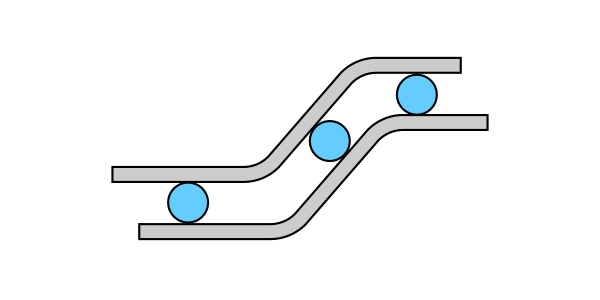
Why you can't use the same marks
Say two conduits run 2″ apart, center to center, and both need the same offset. If you put the marks in the same place on both and bend them the same way, the second conduit is just the first one slid sideways. On the straight runs they're still 2″ apart, but on the diagonal they squeeze together.
On the diagonal, the spacing shrinks to the center-to-center × cos θ. At 30°, 2″ spacing drops to about 1 3/4″. At 45° it drops to about 1 7/16″. That's enough to bang couplings, crowd straps or make the run look sloppy.
To keep the conduits evenly spaced all the way through, each conduit farther from the inside of the first bend has to bend a little later.
Where the adjustment comes from
Picture every conduit's bend corner. To stay parallel, all the corners for one bend have to line up on a single line that splits the bend angle in half. That line is tilted by half the bend angle, so each conduit's corner sits a little farther along than the one inside it.
That tilt makes a small right triangle: one side is the spacing S, the angle opposite the shift is half the bend angle, and the shift is the other side. So:
adjustment = center-to-center spacing × tan(θ ÷ 2)
Both bends of the offset shift by the same amount, so the distance between marks stays the same on every conduit. Only the starting point moves.
Example: conduits 2″ apart, 30° offset. tan(15°) = 0.268, so the adjustment is 2 × 0.268 = 0.536″, about 9/16″. That's exactly what iBend Pipe's Apple Watch app shows for the same inputs.
Why conduit size doesn't matter
Notice what's missing from the formula: the conduit size and the bender radius. The adjustment comes only from where the corners line up, and that depends only on the angle and the spacing between centerlines.
Even with a real centerline bending radius, the radius adds the same amount to every conduit's marks, as long as they're bent with the same bender. So it cancels out, and the adjustment is still center-to-center × tan(θ ÷ 2). Two 1/2″ EMT runs 2″ apart and two 2″ rigid runs 4″ apart follow the same rule. Only the spacing changes the answer.
You've seen these numbers before
tan(θ ÷ 2) is exactly the same number as the shrink per inch of an offset. So the parallel adjustment per inch of spacing is the shrink constant you already know:
| Bend angle | 10° | 22.5° | 30° | 45° | 60° |
|---|---|---|---|---|---|
| Adjustment per inch of spacing | 0.087″ | 0.199″ | 0.268″ | 0.414″ | 0.577″ |
Adjustment by spacing
How far to move each conduit's marks compared with the conduit just inside it:
| Center to center | 10° | 22.5° | 30° | 45° | 60° |
|---|---|---|---|---|---|
| 1 1/2″ | 1/8″ | 5/16″ | 3/8″ | 5/8″ | 7/8″ |
| 2″ | 3/16″ | 3/8″ | 9/16″ | 13/16″ | 1 1/8″ |
| 2 1/2″ | 3/16″ | 1/2″ | 11/16″ | 1 1/16″ | 1 7/16″ |
| 3″ | 1/4″ | 5/8″ | 13/16″ | 1 1/4″ | 1 3/4″ |
| 4″ | 3/8″ | 13/16″ | 1 1/16″ | 1 11/16″ | 2 5/16″ |
| 6″ | 1/2″ | 1 3/16″ | 1 5/8″ | 2 1/2″ | 3 7/16″ |
How to bend a parallel offset
- Find the conduit on the inside of the first bend: the one closest to the direction the offset moves. Lay out and bend its offset as normal.
- For the next conduit out, move both marks farther from the end by the adjustment.
- For each conduit after that, add the adjustment again: the third conduit moves 2 × the adjustment, the fourth 3 ×, and so on.
- Bend every conduit to the same angle. They'll stay evenly spaced through the whole offset.
Work out your adjustment
Results
Move each conduit's marks
iBend Pipe has a parallel offset calculation on iPhone and Apple Watch. Get the app.
Run them all straight.
iBend Pipe handles parallel offsets, rolled offsets and every other bend, on your phone or your wrist.
Get iBend Pipe for $4.99